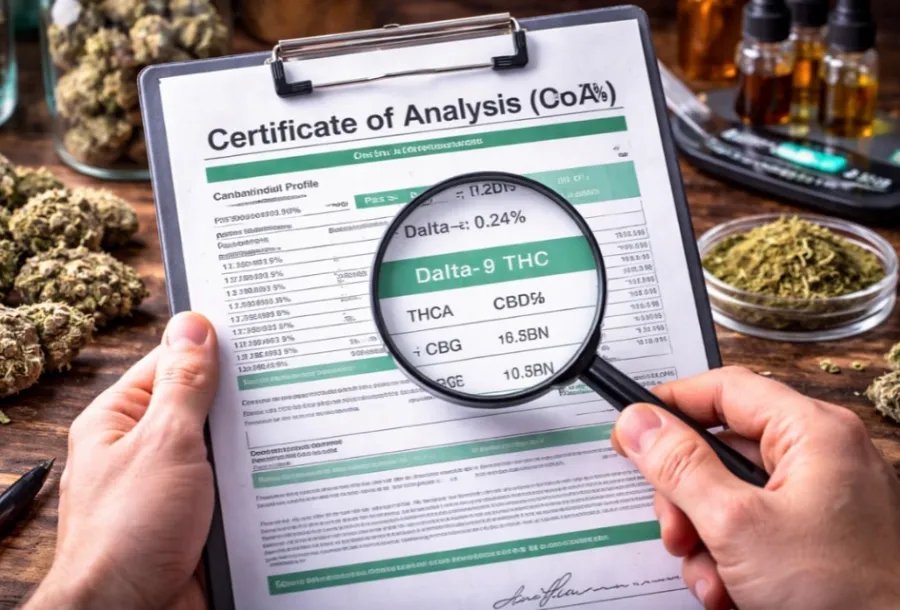
The Alchemist’s Shadow: Beyond the Marketing Facade
In the vibrant, neon-lit aisles of the 2026 Australian wellness market, there is a dangerous seduction occurring. It is the seduction of the label. We are drawn to the minimalist typography, the promises of 'Organic' and 'Pure,' and the aesthetic glass jars that suggest a level of pharmaceutical luxury. But beneath that glass—inside the very molecular structure of the gummy—lies a hidden world. It is a world of shadows where the line between 'healing' and 'harm' is invisible to the naked eye. In this landscape, the only thing that matters is not what the brand says, but what the machine knows.
At GummiesAus.com, we believe that transparency is the ultimate luxury. We don't ask you to trust our word; we ask you to read our ledger. That ledger is the Certificate of Analysis (COA). It is the cryptographic key to the 'Chemical Truth' of every product we sell. As we navigate the complexities of 2026 hemp law and cannabinoid science, understanding how to decipher a COA is no longer a niche skill for chemists—it is an essential survival tool for the modern Australian consumer. This is the definitive guide to reading the biological blueprint of your wellness.
Section 1: The Anatomy of a COA—The Institutional Shield
A Certificate of Analysis is not a marketing brochure; it is a legal and scientific document issued by an independent, third-party laboratory. In 2026, the gold standard for these labs is ISO/IEC 17025 accreditation. If a COA comes from a lab without this badge, it is a document without a spine. The COA represents the 'Institutional Shield'—the only barrier between you and the residual solvents of a poorly managed extraction facility.
When you open a COA, the first thing you must verify is the 'Batch Match.' Every jar of gummies should have a Batch Number that corresponds directly to the report. In the 'Grey Market,' it is a common deception to use a 'Ghost COA'—a pristine report from a batch produced three years ago to sell a contaminated batch produced yesterday. At GummiesAus, our 'Live Ledger' system ensures that the COA you see is the COA for the specific jar in your hand. This is the first rule of the Shield: if the numbers don't match, the trust is broken.
Section 2: Cannabinoid Profiling—The High-Performance Liquid Chromatography (HPLC) Map
The heart of the COA is the Potency Profile. This is where we use HPLC (High-Performance Liquid Chromatography) to separate and identify each individual cannabinoid. The machine creates a 'Chromatogram'—a series of peaks and valleys that represent the molecular concentration of the sample. We are looking for more than just THC and CBD levels; we are looking for the 'Spectrum Integrity.'
In a 2026 'Full Spectrum' gummy, the COA should reveal a symphony of minor players: CBG, CBN, CBC, and THCV. If the report shows only CBD and 'ND' (None Detected) for everything else, you are not holding a Full Spectrum product; you are holding an Isolate masquerading as a premium blend. We also look for the LOQ (Limit of Quantitation)—the threshold below which the machine cannot accurately measure. A 'clean' report will show precise percentages, ensuring that your 25mg gummy is actually 25mg, and not a 'hot' dose that could jeopardize your work-day focus or a roadside drug test.
Section 3: The Chamber of Horrors—Heavy Metals and Pesticide Screening
This is where the COA moves from 'interesting' to 'critical.' Hemp is a 'bio-accumulator'—it is a botanical sponge that sucks everything out of the soil. If that soil is contaminated, the plant is contaminated. The COA's Safety Section is a journey through a 'Chamber of Horrors' that includes Lead, Mercury, Arsenic, and Cadmium.
Using ICP-MS (Inductively Coupled Plasma Mass Spectrometry), labs can detect these metals down to the parts per billion (PPB). In the 2026 market, there is zero room for error. A 'Pass' result on a GummiesAus COA means the levels are so low they are effectively non-existent. We apply the same 'Burnished Standard' to pesticides. With over 60 known pesticides and fungicides used in global hemp farming, our COAs scan for every single one. If the report shows even a trace of Myclobutanil (a common fungicide that turns into Hydrogen Cyanide when heated), that batch is incinerated. This is why we exist: to do the scanning so you don't have to do the suffering.
Section 4: Residual Solvents—The Chemistry of the Extraction
To turn a hemp plant into a 'Liquid Diamond' or a 'Nano-Emulsion,' you must use a solvent. Whether it is CO2, Ethanol, or Butane, the goal of a professional extractor is the 'Total Purge.' The COA’s 'Residual Solvent' section is a testament to the skill of the chemist. We are looking for 'ND' on volatile organic compounds like Hexane, Benzene, and Heptane. In 2026, many low-cost international brands are using industrial-grade solvents that leave behind 'Micro-traces.' These aren't immediately toxic, but they contribute to 'Systemic Bio-accumulation'—a slow-motion toxic load on your liver. A GummiesAus COA is your guarantee that the only thing in your gummy is the plant, not the process.
Section 5: The Terpene Map—The Soul of the Gummy
Finally, we look at the Terpene Profile. In the 2026 era of 'Molecular Wellness,' terpenes are not just for aroma; they are pharmacological modulators. A high-quality COA will include a 'Terpene Map' showing concentrations of Myrcene, Limonene, and Linalool. This map tells you what the experience will be. Is it a 'Sleep' gummy? The COA should confirm high Linalool. Is it a 'Focus' gummy? Look for Pinene. If a brand claims to have 'Live Resin' but the COA shows zero terpenes, they are lying. The COA is the only place where marketing 'hype' is replaced by molecular 'fact.'
Conclusion: Purity as the New Luxury
In the complex, fast-moving world of 2026, we are often overwhelmed by choice. But in the world of ingestible health, there is no choice but purity. The Certificate of Analysis is the bridge between the 'Alchemist’s Shadow' and the light of truth. It is the document that turns a purchase into an investment in your longevity. At GummiesAus.com, we don't just provide COAs because the law requires it; we provide them because your biology deserves it. Learn the ledger. Use the shield. Demand the truth.
Technical Resources and 2026 References
1. ISO/IEC 17025:2026 - General requirements for the competence of testing and calibration laboratories.
2. Journal of Chromatography: Analyzing complex cannabinoid matrices in pectin-based delivery systems.
3. Environmental Health Perspectives: Bio-accumulation of heavy metals in Cannabis Sativa L. and human health risks.
4. TGA Guidance on Quality Standards: Ensuring purity in medicinal cannabis and hemp-derived products.
5. Global GMP Alliance: 2026 Standards for Residual Solvent limits in edible nutraceuticals.